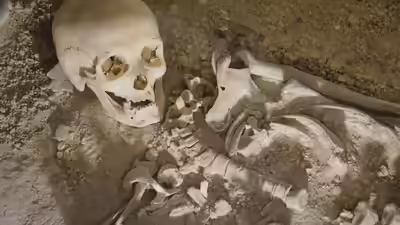
Archaeologists working in central Italy have made an extraordinary discovery that is shedding new light on the ancient Etruscan civilization, one of the most influential cultures in pre-Roman Europe. During excavations at an ancient burial site, researchers uncovered a sealed tomb estimated to be about 2,600 years old.
Inside the burial chamber, scientists discovered the remains of four individuals carefully laid on carved stone beds. Surrounding the skeletons were more than 100 funerary artifacts, including pottery, weapons, bronze ornaments, and delicate silver hair accessories that were likely placed in the tomb as part of ancient funeral rituals.
What makes this discovery especially significant is the condition of the tomb. Unlike many ancient burial sites that were looted over centuries, this tomb remained completely sealed, allowing archaeologists to observe the artifacts exactly as they were originally arranged thousands of years ago. Such intact tombs from this period are extremely rare and provide valuable insights into the traditions and daily life of early Italian societies.
Preliminary studies suggest that the four individuals buried in the chamber may have belonged to a family group, possibly two male-female pairs, although further scientific analysis is still ongoing to determine their identities, age, and social status.
The tomb was discovered as part of an international archaeological research project that aims to better understand how people in Italy lived before the rise of the Roman Empire. Researchers believe that studying the artifacts and human remains could reveal important information about Etruscan burial customs, trade networks, cultural beliefs, and social structures.
The Etruscans were a powerful civilization that flourished in central Italy between the 9th and 1st centuries BCE, influencing Roman culture, architecture, and religion. Discoveries like this tomb help historians piece together the story of a society that played a crucial role in shaping ancient Mediterranean history.
Scientists plan to continue examining the tomb and its contents using modern archaeological techniques. The findings could provide new clues about the people who lived in Italy more than two and a half millennia ago and deepen our understanding of one of Europe’s earliest advanced civilizations.