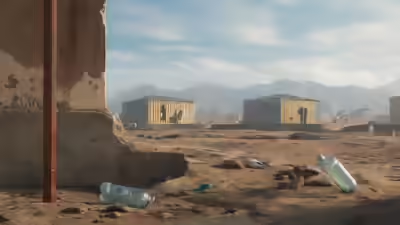
Kabul, the capital of Afghanistan, is facing an escalating water crisis that is raising concerns among experts, humanitarian organizations, and local residents. The city’s rapidly growing population, combined with years of poor infrastructure planning and climate-related challenges, has significantly strained its limited water resources.
For many residents, access to clean water has become a daily struggle. Families often depend on water tankers or private suppliers to meet their basic needs, sometimes spending a significant portion of their income just to secure enough water for drinking, cooking, and sanitation. In some cases, households must make difficult choices between buying food and purchasing water.
Experts say the situation has been worsened by uncontrolled urban expansion and the heavy reliance on groundwater. Kabul currently extracts far more groundwater than can be naturally replenished each year, causing water levels in underground aquifers to fall rapidly. Reports indicate that the city uses around 44 million cubic meters more groundwater annually than nature can restore, a gap that continues to widen as demand increases.
The crisis is also compounded by climate change. Reduced rainfall, rising temperatures, and declining snowfall in the nearby Hindu Kush mountains have limited the natural recharge of groundwater reserves. As a result, many wells across the city have already dried up, and others are producing far less water than before.
Water quality is another major concern. Studies suggest that up to 80% of Kabul’s groundwater is contaminated, often due to poor sanitation systems, sewage leakage, and unregulated drilling of wells. This contamination poses serious public health risks for residents who rely on these sources for drinking water.
If the current situation continues without effective intervention, experts warn that Kabul could become the first modern capital city in the world to completely run out of groundwater by around 2030. Such a scenario could trigger a massive humanitarian emergency, forcing people to migrate in search of water and placing enormous pressure on the country’s already fragile economy and infrastructure.
Despite these challenges, efforts are underway to address the crisis. Authorities and international organizations have proposed infrastructure projects such as dams, improved water management systems, and pipelines to bring water from nearby river basins. However, these projects require significant funding, technical expertise, and long-term planning to succeed.
Until sustainable solutions are implemented, Kabul’s residents will continue to face growing uncertainty over one of the most essential resources for survival — clean water.