The ongoing confrontation between Israel, Iran, and the United States has escalated rapidly, spreading across several parts of the Middle East and increasing fears of a wider regional conflict.
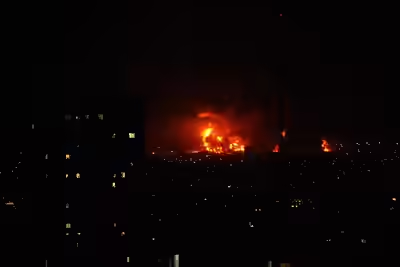
Israel recently expanded its military operations by launching airstrikes on multiple targets in southern Lebanon, Beirut, and Iran. One of the most significant strikes hit an oil storage facility in Tehran, triggering massive flames that lit up the capital’s skyline. The attack is believed to be the first instance during the current conflict where a civilian industrial facility in Tehran has been targeted.
Israeli Prime Minister Benjamin Netanyahu warned that the next phase of the conflict could bring “unexpected developments,” suggesting that additional military actions may follow.
The escalation traces back to February 28, when Israel and the United States carried out coordinated strikes against Iranian military infrastructure. Since then, hundreds of airstrikes have reportedly targeted sites across Iran, Lebanon, and Gaza. Israeli authorities claim that thousands of strategic locations have been hit, including missile manufacturing facilities, bases linked to Iran’s Revolutionary Guard, and internal security command centers.
Iran has responded with several waves of ballistic missile launches aimed at Israel. These attacks triggered air raid sirens in many areas, including the Tel Aviv metropolitan region and locations near Jerusalem. Iran’s retaliation has also reached beyond Israeli territory, with strikes hitting infrastructure connected to the United States in the Gulf region.
One such attack involved a drone strike on a desalination facility in Bahrain, which provides fresh drinking water in the desert region. The attack injured at least 32 civilians and caused concern about the safety of critical infrastructure across the Gulf.
Meanwhile, tensions along Israel’s northern border have intensified as Israeli forces prepare for potential clashes with Hezbollah in Lebanon. Military vehicles, tanks, and troops have been deployed in greater numbers following rocket launches from the Iran-backed militant group.
According to conflict monitoring organizations, the war has already triggered more than 1,000 violent incidents across at least 16 countries within its first week. Several attacks have struck civilian areas in Iran, leading to significant casualties and raising serious humanitarian concerns.
The widening conflict is also drawing the attention of major global powers and affecting international markets. Energy prices have become volatile, and regional travel disruptions are increasing as governments assess the security risks.
With multiple countries already involved and tensions continuing to rise, analysts warn that the situation could escalate further into a prolonged and complex regional war.