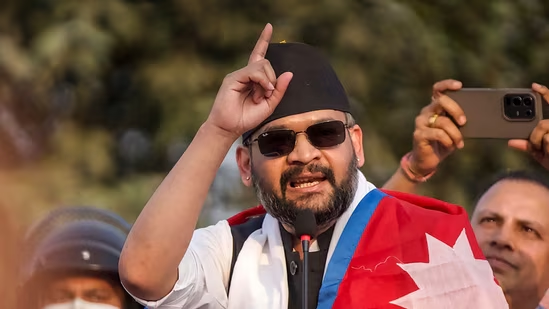
Nepal’s political landscape is undergoing a major transformation following the 2026 parliamentary elections, where the relatively new Rastriya Swatantra Party (RSP) led by Balendra Shah has achieved a sweeping electoral success. Early vote-counting trends show the party winning several seats and leading in a large number of constituencies, indicating a possible landslide victory.
Shah, a 35-year-old rapper-turned-politician popularly known as Balen, defeated former prime minister KP Sharma Oli of the Communist Party of Nepal (Unified Marxist–Leninist) by a massive margin in the Jhapa-5 constituency. According to the Election Commission, Shah secured over 68,000 votes, while Oli received around 18,000 votes, marking one of the most decisive defeats for a veteran political leader in recent Nepali history.
The election results suggest a significant shift away from Nepal’s long-standing political establishment. Traditional parties such as the Nepali Congress and the CPN-UML, which have dominated national politics for decades, appear to have lost substantial ground to Shah’s anti-establishment movement.
Much of the momentum behind Shah’s rise has been driven by young voters, especially Gen Z, whose frustration with corruption, unemployment, and the political status quo culminated in mass protests in 2025. Those demonstrations, which involved thousands of young Nepalis taking to the streets, eventually led to the resignation of the government led by KP Sharma Oli.
Shah capitalized on this wave of public discontent through strong digital outreach, social media engagement, and messaging focused on reform and accountability. His campaign resonated particularly with urban youth who demanded new leadership and a break from traditional political elites.
The elections also recorded a voter turnout of around 60 percent, with election officials noting unusually strong participation among young voters. Authorities described the process as largely peaceful, thanks to extensive security arrangements and cooperation among political parties and institutions.
Nepal elects members to its 275-seat House of Representatives through a mixed electoral system. Of these, 165 seats are decided through direct constituency elections under the first-past-the-post system, while the remaining 110 seats are allocated through proportional representation based on each party’s share of the vote.
The outcome of the 2026 election could mark the beginning of a new political era in Nepal. With Shah’s RSP poised to play a leading role in forming the government, the country may witness a generational transition in leadership and a renewed focus on governance reforms and youth-driven politics.